In Greenwich, the right train station is not always the closest one.
Greenwich has four New Haven Line stations: Greenwich, Cos Cob, Riverside, and Old Greenwich. Greenwich is the main station and tends to get the faster trains to Grand Central; the other three are local stops. But the schedule rarely decides the commute. Where you live, whether you can park, whether school drop-off comes first, and what your evening pickup looks like usually settle it before you reach the platform — and those four stations can produce very different weekdays.
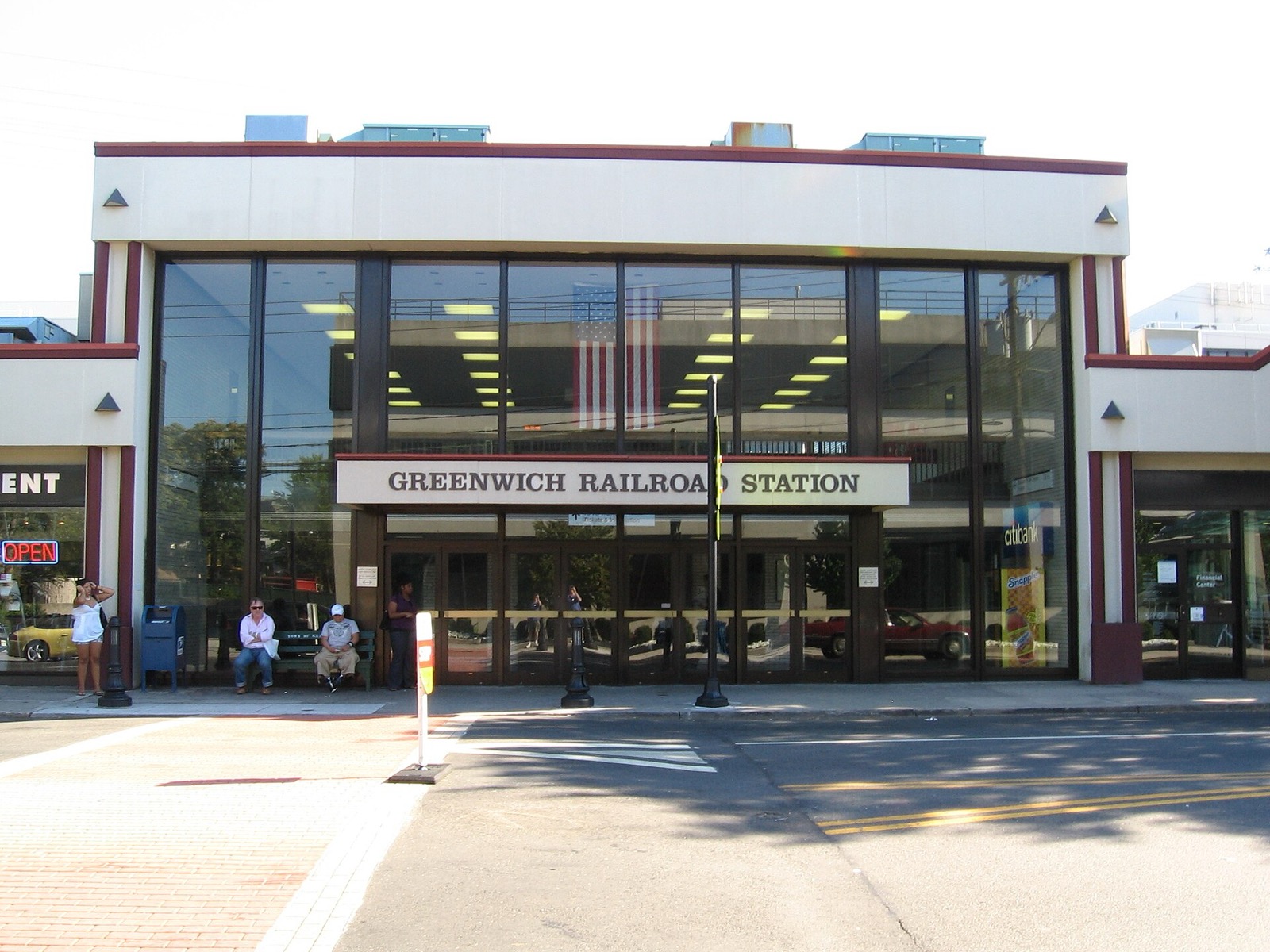
Greenwich station, where commute plans, parking, and downtown routines meet.
Image: Picabu / Wikimedia Commons, Public domain. Source
Last checked: Town parking sources reviewed June 3, 2026. MTA pages block automated checks, so open the MTA Metro-North site in your own browser for current timetables, fares, and alerts — do not trust a commute time you read here over the live timetable. Permits, fees, and waitlists change; verify with Greenwich Parking Services before deciding.
Start with the commute problem, not the station name
Most Greenwich train mistakes start with a listing shortcut: “near Greenwich Station,” “walk to Old Greenwich,” “easy train.” Before you check schedules or parking, name the morning you actually have to solve — the one with the school stop, the 7:48, and the bad left turn in it.
First decision
You need a dependable weekday commute from a new address.
Choose the station after you test the morning drive or walk, the evening return, and the parking backup. Do not let the listing copy pick the station for you.
Check next: MTA schedule for the actual train window; Parking Services permit category and waitlist path; daily parking or drop-off backup.
First decision
School drop-off or child care comes before the train.
Run the school stop first, then choose the station. A station that looks close on the map can add a bad left turn, a late pickup problem, or a parking scramble.
Check next: Exact school route, drop-off timing, station access, and who covers delays or a late meeting.
First decision
You only need the train a few days a week.
Treat this as a friction test, not a permit-first decision. Occasional riders can sometimes tolerate a longer walk, ride, or paid option that would be maddening five days a week.
Check next: Daily parking rules, weekend/holiday exceptions, and return-trip timing after dinner or a late meeting.
First decision
Guests are arriving by train.
Use the station that fits the pickup and plan after arrival. Downtown dinner points to Greenwich; Old Greenwich or Riverside can make more sense for east-side family plans.
Check next: Arrival time, pickup curb/parking plan, and whether the rest of the day is Avenue, beach, museum, or home-based.
Station matrix: what changes before you board
“Easy train” sounds simple until you add the rest: a stroller, an injury, an aging parent, the school drop-off, a late return, a permit waitlist, the subway transfer after Grand Central. Use this as a first-pass filter, then confirm trains on the MTA timetable and parking with Greenwich Parking Services.
Station
Trains
Access note
Best daily fit
Parking posture
Watch
Greenwich
Main station; tends to get the faster trains to Grand Central.
MTA lists Greenwich as accessible, with elevators.
Best when downtown, Greenwich Avenue, office visits, or visitor pickup is part of the day.
Plan for a long permit path: published estimates put the outdoor Greenwich list around five years and the covered Plaza garage around ten.
The fastest trains and the worst parking sit at the same station.
Cos Cob
Local stop; expect a few extra minutes versus the faster Greenwich trains.
MTA notes ramp access to platforms but no accessible route between them; it points riders to Greenwich or Stamford for a fully accessible station.
Best to test if home, school, errands, or child care sit between central Greenwich and the east side.
Shortest published estimate in this set, about one year; still verify with Parking Services.
Practical without feeling like a downtown plan, but route timing matters.
Riverside
Local stop; usually a few minutes longer than boarding at Greenwich.
Ramp access to platforms per MTA, but no accessible path between them; nearest fully accessible stations are Greenwich and Stamford.
Best for east-side routines when the morning already points toward Riverside.
Published estimates put the permit wait around three to five years; daily parking and drop-off still need a plan.
Works differently for a walker, a driver, a parent doing pickup, and a hybrid commuter.
Old Greenwich
Local stop; the easternmost Greenwich station, a few minutes longer.
MTA notes ramp access to platforms, but no accessible route between platforms.
Best when Old Greenwich village, Tod’s Point, or east-side family errands are the center of gravity.
Permit wait runs roughly three to five years by published estimates; do not confuse commuter parking with beach-season assumptions.
The nicest weekend station may not be the easiest weekday commute.
The Greenwich station that usually gets the faster trains to Grand Central, and the one tied to Greenwich Avenue errands and dinners.
Also the hardest parking: the outdoor and Plaza-garage permit lists are the longest in town.
Check garage, permit, and short-term parking rules before you build a routine around it.
Central/east Greenwich practicality
Cos Cob
A local stop, so usually a few minutes slower than the faster Greenwich trains, but with the shortest published permit wait of the four.
Worth comparing if your errands, school route, or home base sit between central Greenwich and Riverside.
Permit rules and the Cos Cob waitlist still decide whether the car can stay there.
East-side residential and family routines
Riverside
A local stop that saves the backtrack toward downtown if you live east.
The real decision is the drive, the drop-off pattern, and who covers evening pickup — not the platform.
Check the MTA timetable and the Riverside permit waitlist directly.
Old Greenwich village, Tod’s Point routines, east-side visitors
Old Greenwich
The easternmost local stop, walkable to Sound Beach Avenue and handy for weekend and visitor trips.
Good for beach-day and guest pickups; a different problem from a five-day permit commute.
Summer beach traffic and weekday commuter parking do not behave the same way.
Parking is not a footnote
The Town says annual parking permits are administered through Parking Services, are valid only in designated lots, and new annual permits use waitlists for various lots. That means a house that looks “near the train” on a map may still need a real parking plan, a walking plan, a drop-off plan, or a different station strategy.
If you are comparing homes, check the actual lot or garage tied to the station you expect to use, not just the distance from the house to the tracks.
The Town’s parking permit page lists resident commuter permits and resident/non-resident commuter Metro-North permit categories, including Cos Cob, Old Greenwich, and Riverside railroad station lots. Fees, eligibility, renewals, and waitlist rules can change, so use the Town pages before making a housing or commute decision around them.
Permit waitlist reality by station
This is the part relocation blurbs usually skip: Greenwich train parking can be a multi-year project. The Town’s official portal lets applicants join and search waitlists by lot, but it does not publish a simple “you will wait X years” promise. For planning, use the official lot categories first, then treat published local wait-time estimates as directional and call Greenwich Parking Services before making a home or commute decision.
Permit target
Published wait estimate
Official lot path
What it means
Greenwich Station — outdoor / station-area commuter permit
about 5 years
Town waitlist portal lists Greenwich as its own waitlist category.
Treat this as a long-game permit, not a move-in-ready commute plan.
Greenwich Plaza garage / covered parking
about 10 years
Town rate schedule lists Greenwich Plaza, Level A as a separate permit category.
This is the covered-garage option; plan as if it will not solve the first several years of commuting.
Cos Cob
about 1 year
Town waitlist portal lists Cos Cob; the Town parking report describes Cos Cob as one of the railroad permit lots.
Often the most realistic permit target if the station fits your actual morning route.
Riverside
about 3–5 years
Town waitlist portal lists Riverside; the Town parking report describes Riverside as one of the railroad permit lots.
Good east-side fit, but still a multi-year parking problem for many households.
Old Greenwich
about 3–5 years
Town waitlist portal lists Old Greenwich; the Town parking report describes Old Greenwich as one of the railroad permit lots.
Do not buy the commute only on village charm; verify the parking path first.
Two details are easy to miss. First, Greenwich and Plaza appear as separate waitlist categories in the Town portal; “Greenwich Station parking” is not one single thing. Second, the Town’s parking operations report says railroad waitlist offers generally happen after renewals, with letters sent if spaces become available from roughly December through April. In other words: even if you join today, the useful question is not just your place in line, but which lot you joined and how many renewals actually turn over.
How to choose the station you will actually use
If the fastest ride is the priority: Greenwich Station usually gets the quicker trains, but weigh that against the longest parking waitlists in town.
If Greenwich Avenue is part of your day: Greenwich Station puts downtown meetings, meals, and errands at the platform.
If school drop-off comes first: the closest station may not be the practical one. Test the route after the real morning stop.
If you are moving from NYC: do not assume the station with the familiar name is the station your daily life will use.
If you work hybrid: weekend and occasional train use can be much easier than a five-day permit commute.
If you live east: Riverside or Old Greenwich may fit better than doubling back toward downtown.
The commute questions people under-ask
The train ride is only the visible part. The household question is whether the commute still works on a hard weekday.
Door-to-desk matters more than platform-to-Grand-Central. Add the subway, walk, office elevator, and recurring meeting time.
A new-parent or two-career commute needs backup coverage: train delays, sick kid, late meeting, and who can do pickup.
The closest station is not always the best station if parking, drop-off, or the school route breaks the morning.
Hybrid work changes the decision. A two-day commute can tolerate more friction than a five-day permit routine.
Visitor pickup, late dinner return, and weekend train use are different problems from weekday commuting.
Weekend train use is a different question
A Saturday train into the city, a visitor pickup, or a late dinner return is not the same problem as a weekday permit commute. Before choosing a weekend plan, check MTA schedules and Town parking rules for the specific day. The Town parking page notes weekend/holiday parking exceptions for some Metro-North-owned lots, but also lists exclusions that matter during beach-ferry season, June through September, and at Greenwich Plaza.
For relocation: make Metro-North part of the neighborhood decision
Greenwich neighborhoods feel different partly because the train math is different. Downtown, Cos Cob, Riverside, Old Greenwich, Glenville, Byram, and backcountry do not solve the commute the same way. If a listing depends on “easy train access,” test the exact morning and evening route before believing the phrase.
Greenwich Time commuter parking reporting — local reporting that Greenwich commuter permit waits can run two or three years and explains why empty spaces can coexist with waitlists
Suburbs 101 waitlist guide — published local wait-time estimates used directionally here; verify before making decisions
Greenwich Metro-North questions, answered
How many Metro-North stations are in Greenwich?
Four, all on the New Haven Line: Greenwich, Cos Cob, Riverside, and Old Greenwich. Greenwich is the main station and tends to get the faster trains to Grand Central; Cos Cob, Riverside, and Old Greenwich are local stops, so they usually add a few minutes. Open the MTA timetable directly for the exact trains on your day.
Which Greenwich station has the fastest trains to Grand Central?
Usually Greenwich Station. As the main station it tends to get more of the faster trains, while Cos Cob, Riverside, and Old Greenwich are local stops that often add a few minutes. That gap adds up across a week, but parking and your home-to-platform route usually decide more than it does. The pattern varies by time of day, so confirm timing on the MTA timetable.
Is Greenwich Station always the best station to use?
No. Greenwich Station suits downtown, Greenwich Avenue, and office meetings, and it usually has the faster trains, but Cos Cob, Riverside, or Old Greenwich can beat it once you factor in where you live, whether you can park, school drop-off, and your evening pickup.
How does commuter parking work in Greenwich?
The Town runs annual permits through Parking Services, and each permit is valid only in its designated lot. New permits go onto waitlists by lot. Check Greenwich Parking Services and the Parking Permits page for current rules before you build a commute around any station.
How long is the Greenwich train station parking waitlist?
The Town portal lets you join and search a waitlist by lot, but it does not publish a guaranteed wait. Published local estimates run roughly five years for Greenwich outdoor permits, about ten years for the covered Greenwich Plaza garage, about one year for Cos Cob, and about three to five years for Riverside and Old Greenwich. Treat those as directional and confirm with Parking Services before relying on them.
We do not include paid placements unless the page says so. These links are the source list for this guide. Rules, hours, access, and business details can change, and some official or business sites may block automated checks. Please check the linked official or business source before making plans.
The Greenwich Weekend List
Know what’s worth doing in Greenwich this weekend.
A short local email with weekend events, dinner ideas, kid-friendly stops, beach and park reminders,
and a few Greenwich notes to check before you leave the house.