Downtown Greenwich is the easiest place to feel the town moving.
Downtown Greenwich is the half-mile around Greenwich Avenue and the main train station where errands, restaurants, the library, coffee, dinner, and an out-of-town guest can fit into one trip on foot. That is the appeal. The honest version adds the meter rules, the hill, the commuter crush, the permit waitlist, and whether the exact block gives you that convenience without putting you in the middle of the bustle.
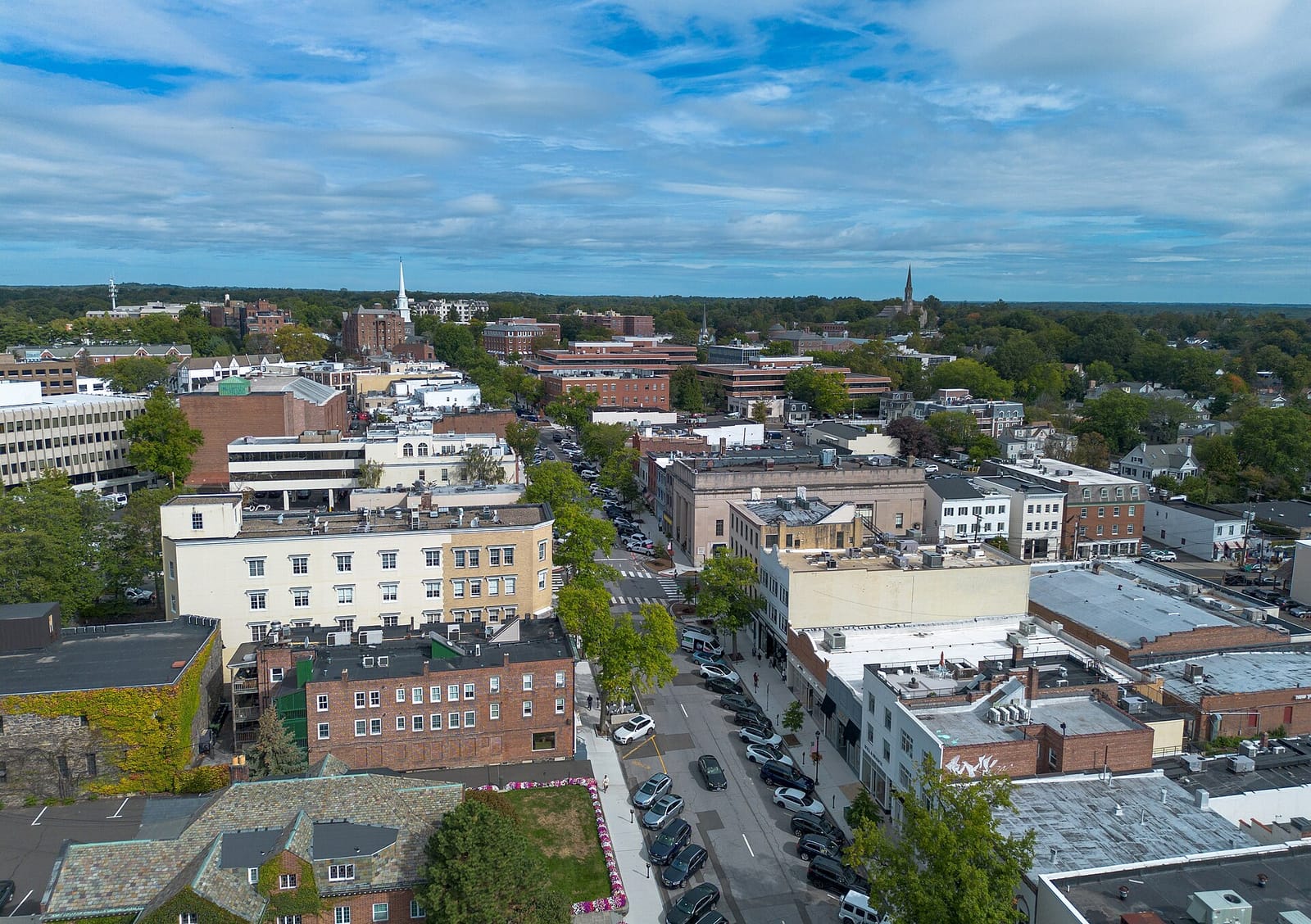
Greenwich Avenue and the downtown grid from above — the shopping, dining, and errand heart of town.
Image: Hayden Soloviev / Wikimedia Commons, CC BY 4.0. Source
Last checked: Source links spot-checked June 3, 2026. Train service, parking and meter rules, rate schedules, business and gallery hours, library access, and event calendars all change; verify through official or owned sources before you build a plan around them.
What downtown makes easier
Downtown works differently for a commuter, a dinner guest, a parent on errands, and someone making one Avenue stop. Pick the job you want downtown to do, then see whether the block makes that job easy.
If you are choosing an address
Walk the weekday, not the brochure block.
Start at the front door and time three walks: to the train, to the grocery or pharmacy you would actually use, and to the garage you would fall back on in February rain. The Avenue runs about a half-mile downhill from the Post Road to the station, so a block two over can still mean a hill and a crossing.
If guests are coming
Lock the station pickup and dinner first.
Downtown is genuinely easy on visitors when the train, the Avenue walk, the restaurant, and a backup garage line up. Book the table, then decide where the car goes. The main station gets the express trains from Grand Central, so a guest arrives sooner than the local stops allow.
If this is a parent errand loop
Test the hour when everyone else is moving.
Library, a quick appointment, a pickup, food, and a parking task can chain into one trip here. Run it at 3 p.m. pickup or the 5:30 commuter crush, not just a quiet Tuesday morning, because that is when the Avenue and the lots fill.
If you just need a quick Avenue stop
Read the meter before you read the menu.
The Town enforces Avenue meters Monday through Saturday, roughly 9 a.m. to 5 p.m., with two-hour limits on the street; longer stays belong in a downtown lot or garage. Confirm the current rule on the block you park on, because rates and posted limits change.
Test the loops you would actually repeat
An address sells itself on the brochure walk. What matters is the loop you run twice a week without thinking about it. Walk or drive these before you decide whether “near the Avenue” is useful or just nice to say.
Morning station loop
Home to the main station, coffee on the way, then back through one errand
Tells you whether the express-train advantage is a real routine or a daily parking puzzle. Time it on a workday, not a relaxed Saturday.
Midday errand loop
Library, one Avenue stop, and a meter or short-stay garage task
Downtown earns its keep when small tasks chain instead of becoming three car trips. The library on West Putnam anchors this one.
After-school / after-work loop
Activity pickup, a service stop, and a weeknight dinner plan
Catches whether downtown smooths the evening or jams up when commuter trains and school pickups land at once.
Saturday visitor loop
Greenwich Avenue, Greenwich Common Park, one restaurant or coffee, and a station pickup
A good downtown plan works for guests without pretending every stop is effortless. Park once, walk the Avenue, let the Common be the kids’ reset.
What downtown Greenwich means in real life
Greenwich Avenue is the spine, but downtown is wider than the storefronts. It is the train, the side-street restaurants and coffee shops, the salons and studios, the banks and offices, the dentist and the dry cleaner, and the library. Locals live here because those add up to one route instead of five car trips; timing matters more than it does in the backcountry because everyone else is using the same compact grid at the same hours.
The Avenue runs roughly a half-mile downhill, Post Road at the top to the station near the bottom, and it is worth walking before you commit. A home above the Post Road and one near the water are both “downtown” but sit on different hills and different walks. The street also turns over: St. Moritz, the European bakery on the lower Avenue, closed in 2025 after nearly 90 years, with local reporting citing a building sale, rising costs, and parking pressure, even as newer New York imports keep arriving.
Parking and the contested street
Downtown is the easiest part of Greenwich to use without a cross-town drive, and the part where parking rules are daily life, not a footnote. On the Avenue, the Town enforces meters Monday through Saturday, roughly 9 a.m. to 5 p.m., with two-hour street limits; anything longer belongs in a downtown lot or garage. Confirm the current rate and posted limit with Greenwich Parking Services, because the schedule and signs change.
Parking here is genuinely contested. For several seasons the Town has run a summer outdoor-dining program that encloses on-street spaces for restaurant seating; in 2025, local reporting put that at roughly 50 of the Avenue's 400-odd stalls pulled out of rotation for the season, and in 2023 a downtown shopkeeper sued the Planning and Zoning Commission, arguing that dining in parking spaces is unfair to retailers. We are not picking a side here; just plan around it, because some of the most convenient spaces are gone in the warm months. And if you commute, the bigger constraint, covered in our Metro-North guide, is that a monthly permit at the main station is known to carry a long waitlist.
The library, the Common, and a reason to stay downtown
Downtown is not only retail and reservations. Greenwich Library on West Putnam Avenue is a real civic anchor, with programs, meeting space, and the Flinn Gallery upstairs running rotating exhibitions; the Greenwich Arts Council and the Chamber merchant calendar fill in the rest of the cultural week. Mid-errand, Greenwich Common Park sits right on the Avenue with a playground and open lawn, the obvious reset when kids are with you. For a fuller weekend, our roundup of things to do in Greenwich and the best restaurants picks up where the Avenue walk leaves off.
Fit check
Downtown buys you walkability and trades you quiet. Decide which one you came for.
Exact-block decision
Downtown works best if
You want the express train, the Avenue, the library, restaurants, services, and appointments inside one compact walking radius.
You are comfortable reading meters and signs and switching between street parking, a garage, or walking from home depending on the trip.
You like having the town moving around you and would trade some quiet for being able to leave the car home most days.
Check twice if
You are assuming downtown means car-light living without testing the grocery run, school and activity routes, beach trips, and weekend drives out of town.
Your ideal Greenwich week is privacy, acreage, a beach-first routine, or driveway-to-everything simplicity.
A listing leans on “near the Avenue” but the real walk crosses the Post Road, climbs a hill, or depends on a commuter permit you do not yet hold.
Best evidenceWalk it at 10 a.m. and 5:30 p.m.
Main cautionParking, the hill, and timing reshape the day
Is downtown Greenwich the most walkable part of Greenwich?
For errands, restaurants, offices, the library, and train access, downtown is the most walkable routine in town. The Avenue alone runs roughly a half-mile from the Post Road down to the station, and most of what a weekday needs sits within a few blocks of it. Exact address still matters: parking, the hill, traffic, and timing can reshape a day even when the map looks simple.
Do downtown Greenwich residents need a car?
Most still own one, but downtown is the one part of town where you can leave it home for a real share of the week. Coffee, the library, a meal, and a train can all happen on foot. You will still want a car for the bigger grocery run, school or activity routes, the beach, and weekend trips out of town, so test those before deciding how car-light your week can be.
What is the advantage of living near the main Greenwich station?
The main station gets the faster express trains to Grand Central, while Cos Cob, Riverside, and Old Greenwich are local stops that take a little longer. The catch is parking: a monthly commuter permit at the main station is known for a long waitlist, sometimes years, so confirm where you would actually park before you treat the express train as your daily plan.
What should I check before choosing a downtown Greenwich address?
Walk the route to the station, the Avenue, the library or services you expect to use, and one evening restaurant. Then run those walks again at the hours you would really be there: morning train, school pickup, the 5:30 commuter wave, and a weeknight dinner. That is when parking pressure and traffic actually show up.
We do not include paid placements unless the page says so. These links are the source list for this guide. Rules, hours, access, and business details can change, and some official or business sites may block automated checks. Please check the linked official or business source before making plans.
The Greenwich Weekend List
Know what’s worth doing in Greenwich this weekend.
A short local email with weekend events, dinner ideas, kid-friendly stops, beach and park reminders,
and a few Greenwich notes to check before you leave the house.